

Have you ever wondered how a new piece of music is brought into existence by a composer? Let me tell you about my compositional process and the story of a recent commission – Your Echo Around Me…
The spark that lights the fuse
To begin, as you might expect, a choir will reach out to me to discuss the possibility of a commission. Many groups consider commissioning when they have a special moment they’d like to mark – a choir anniversary, the retirement of a musical director, a festival or tour performance, or in some special cases to remember a chorister or family member who has passed; these are often the commissions that I find the most meaningful to work on – those with a strong relationship-based connection or story.
In the case of Your Echo Around Me the commissioning choir was the Junior Amabile Singers of London, Ontario, Canada. They asked me to write a piece to surprise Jackie Norman, the longstanding director of the choir, who was retiring from JAS, in recognition of her contribution. What made this particularly special for me, was that I had been led by this same director when I sang with JAS between the ages of 10 and 16!
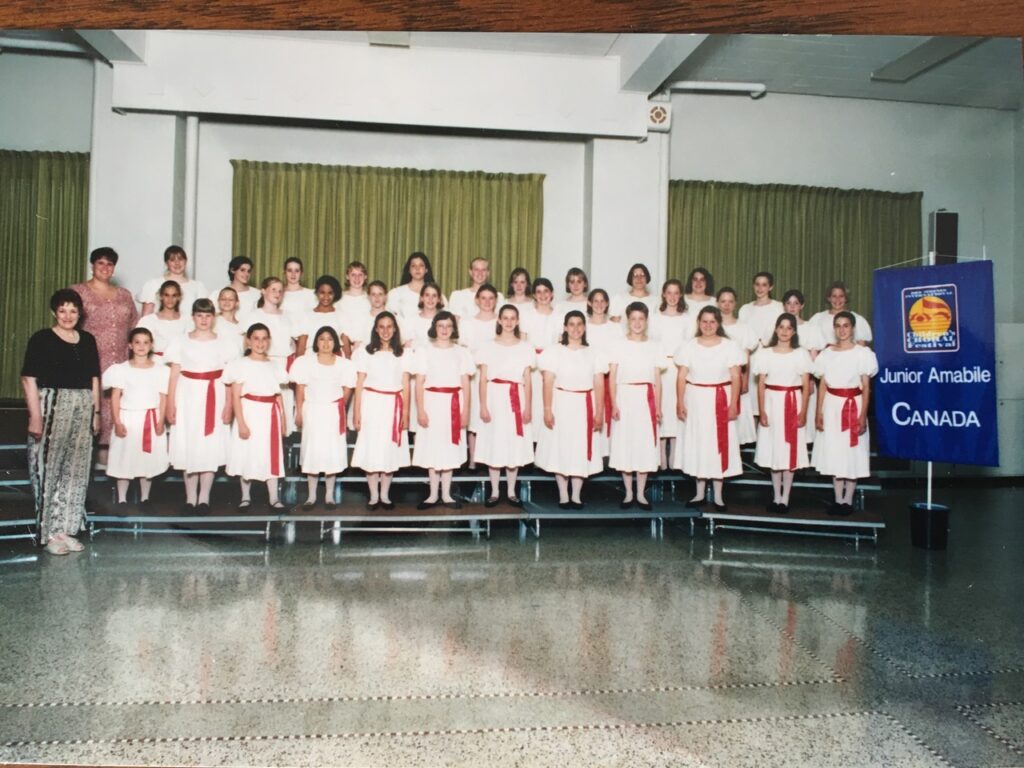
[Image above shows the Junior Amabile Singers with a very young Sarah Quartel standing in the centre of the front row!]
Building a picture
Before anything gets written, I meet with the commissioning director to discuss the technical specifications for the piece. We consider voicing and instrumentation, length of the piece, difficulty level, general theme for the text, and any particular goals the conductor may have.
I also spend time researching the choral organization to ensure that I understand exactly who I am writing for. My goal is to write something that matches the spirit of the ensemble so the end result is something we all feel a strong connection to. I read the choir’s mission statement and online messaging, listen to recordings of their performances, and familiarize myself with the style and difficulty level of the music they have programmed recently.
In the case of Your Echo Around Me, my familiarity with both the choir and the director made this process particularly straightforward.
Selecting a text
This is the single most influential element on how the finished piece turns out. Finding a text that speaks to me and inspires me is the first step of shaping the piece. During the selection process, I scour the internet and spend time in my local university library to explore the thousands of texts just waiting to be found! I will also look through quotes and poems I’ve bookmarked over the years, or, on occasion, I will write my own text.
When I write my own text, I sometimes like to include the choristers and artistic staff of the commissioning ensemble in this process. If the work is to be on a topic that’s particularly personal to the choir, I find including them in this step to be very inspiring for me and exciting for them. I will send the group a few questions for them to answer and invite them to write to me sharing their thoughts and reflections. I allow their responses to inspire the poetry I compose for the commission.
Your Echo Around Me is a good example of this process because I wrote the lyrics for the piece inspired by reflections sent to me from the choir. I asked them to share with me what their conductor means to them, and the impact her support and help had on them both individually and collectively.
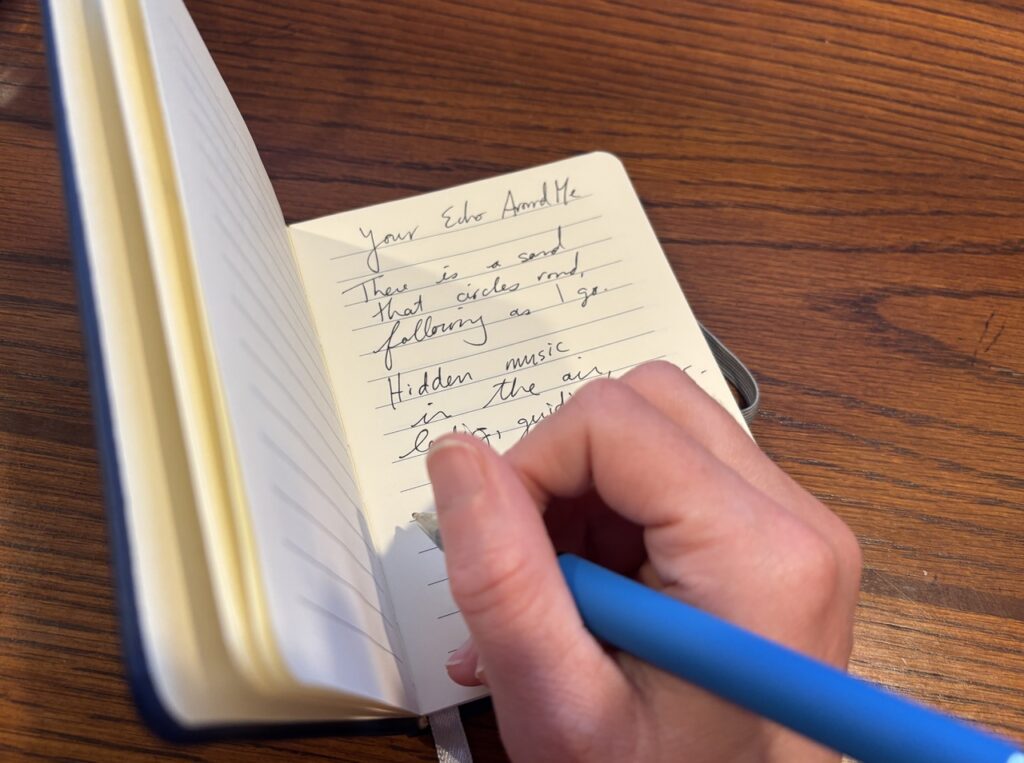
When l invite commissioners to participate, I’m always moved by the care and thought they put into their responses. It feels like such a special way to connect with the musicians and give them a voice in the creation of their commission. I treasure every response I receive!
From poem to piece
Once the poem for the piece is settled, I spend a period of time memorizing and internalizing the words. I look at the formal structure of the poem and decide how to follow that form in the musical setting – will there be verses and choruses? Will it be through-composed? The structure of the poem, development of themes, and favourite lines or words in the text influence how I map out verses, choruses, links, or any moments of departure or shift.
Next, I unpick the content of the poem to get a sense of the ebb and flow of the text. I will search for moments to highlight such as a repeated stanza or stylistic pattern. I pull out specific words that could be given additional emphasis or priority when text painting and I identify moments of build and destination.
Once the basic building blocks are in place, I begin exploring melodic ideas to bring the words of the poem to life (as a singer my brain automatically starts here!). Once the melody line feels right, I’ll flesh out the harmonic progressions and texture by adding other voices.
Next I add any accompaniment. If it is on a keyboard instrument such as piano or organ, I play the part many times myself reworking and changing it until it feels good in the hands, idiomatic, and aligns to an appropriate skill level for this type of piece.
Finally, I sing through all the parts. I want to ensure it feels good in the voice. If the tempo, key, or voice leading need to be shifted, I do that without hesitation – chorister vocal health and experience is my top priority.
Knowing when a piece is complete
Usually I will finish the first full draft of a piece and then sit with it for a while before returning to refine and polish it with fresh eyes and ears. But there is always a moment when you have to let go and submit a piece to the commissioner. Knowing when it feels complete is a key skill.
I know a piece is finished when I’ve sung through every part, played the piano part multiple times, made a recording of myself singing every line, and listened through this recording with critical ears. If it feels good in the voice, feels good in the hands, and sounds good in the ear, then I know it’s finished and ready for submission.
From paper to premiere
The initial score is sent by email to the conductor for them to review and share feedback. Once we are both happy with it, scores are distributed to the choir for rehearsals before the premiere. Occasionally, I may receive a recording of the piece in rehearsal or visit with the choir over video call. It is such an amazing feeling hearing the piece come to life! If after hearing the work I determine any adjustments are needed, I may make slight changes. However, I rarely do that at this stage – I’ve lived with the piece for so long and gone over and over it that I know every note, dynamic, and phrase were carefully selected.
Because the choirs I work with are from all over the world, I don’t often get to hear a new piece live in rehearsal or concert. But on the lucky occasion I get to work with a local choir, like when writing Your Echo Around Me, having a premiere close to home is very special. I do often receive recordings of premiere performances and it is always an emotional moment for me. There is nothing more satisfying than hearing the choir buzzing with excitement from being the first group to perform these new notes composed specially for them.
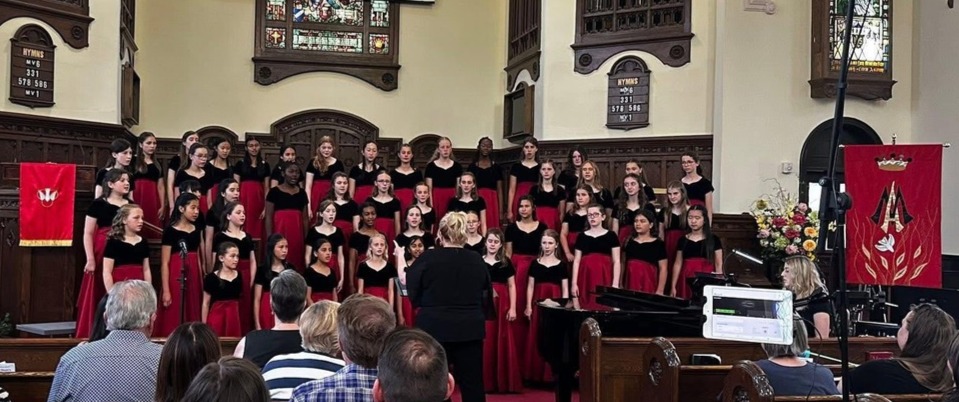
[Junior Amabile Singers performing at the 2026 premiere of Your Echo Around Me, conducted by Tammy Rees]
Find out more about Your Echo Around Me
Would your choir like to work with me on a special commission? Please get in touch if you have an idea in mind.